


Aging · 6
Research on how we age, healthspan and what the evidence says about slowing it.
- AgingPost
Gene in worms and lifespan: what a social media post reports
A social media post describes experiments with worms in which switching off one gene reportedly doubled lifespan, including in older worms. The result has not yet been checked against a peer-reviewed publication.
- AgingPost
Human partial reprogramming eye study for glaucoma and NAION completes enrollment
A first-in-human study testing partial cellular reprogramming in the eye has completed enrollment. Safety data are expected in Q4 2026, and no efficacy results have been released yet.
- AgingPost
Information loss theory of aging: an unproven hypothesis from a 2008 lab
An article presents the claim that aging may stem from loss of epigenetic information after DNA breaks, citing 2008 work from a Sinclair lab. It is a debated hypothesis, not a proven result.
- AgingPost
Partial cell reprogramming and aging in mice
A social media post describes studies in mice in which partial cell reprogramming made old animals younger and, according to the text, about 30% longer-lived. The results come from animal research.
- AgingPost
Senolytic and NAD-boosting combination extended mouse lifespan by 33%
In mice, an oral combination of quercetin, NR, urolithin A and alpha-lipoic acid, started at 18 months of age, increased median remaining survival by 33%. The results are early and do not show an effect in people.
- AgingPost
SGLT2 inhibitor linked to longer telomeres in diabetes trial
A randomized, double-blind trial of 150 adults with type 2 diabetes linked henagliflozina, an SGLT2 inhibitor, to longer telomeres after 26 weeks, compared with placebo.
- AgingPost
Three-Year Study Reports Brain Health Gains at Advanced Ages
A three-year study of nearly 4,000 adults reported improved brain health at any age, including people in their 80s and 90s. The researchers say the results challenge the idea that cognitive decline is inevitable.
- AgingPost
An Opinion Piece Argues Aging Mixes Random Damage and Regulated Processes
An opinion article, citing an unnamed review, proposes that aging combines accumulated errors whose rate is shaped by evolved regulatory networks, rather than being either purely random damage or programmed death.
- AgingPost
Ant study links a peptide to caste switch and longer lifespan
A study in Harpegnathos ants reports that the peptide HCRG1 suppresses juvenile hormone and coordinates changes in reproduction and lifespan in these insects.
- AgingPaper
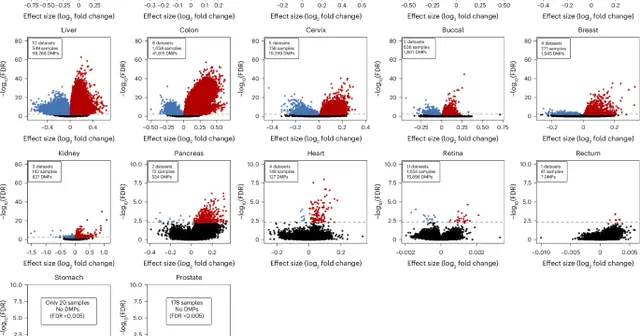
DNA methylation aging differs across 17 human tissues
A computational meta-analysis of nearly 16,000 human DNA methylation profiles found aging marks shared across tissues, but also many changes specific to each organ.
- AgingPost
Early trial of AMPK activator ATX-304 reports metabolic changes
An early phase 1b trial in people with obesity or prediabetes reported improvements in liver fat, visceral fat and resting metabolic rate after 8 weeks of taking the compound ATX-304.
- AgingArticle
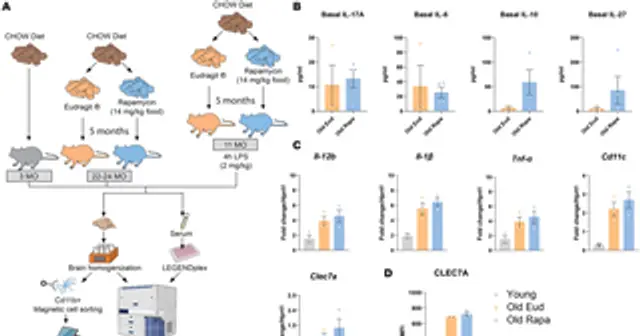
Long-term low-dose rapamycin and aging-linked immune cells
A study published in PLOS ONE reports that long-term exposure to low-dose rapamycin limited the expansion of age-linked gamma delta T cells and neuroinflammation, with small overall immune changes. The findings are preliminary.
- AgingArticle
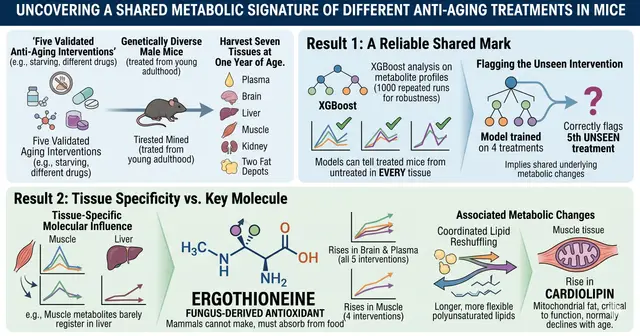
Partly overlapping metabolic patterns across five aging-related interventions
A study in mice compared five aging-related interventions across seven tissues. Metabolic patterns partly overlapped, and a machine learning model could identify the treated mice.
- AgingArticle
Review examines biological clocks that track aging through blood proteins
A review by Eric Topol and a coauthor examines so-called biological clocks, which estimate the pace of aging from blood proteins, and links them to functional health, longevity and disease.
- AgingPost
Social media post claims aging shifts at ages 33, 60, 69 and 78
A social media post says a Nature Medicine article found 'aging waves' across 7 studies, around ages 33, 60, 69 and 78. This piece explains the idea and the questions it still leaves open.
- AgingVideo
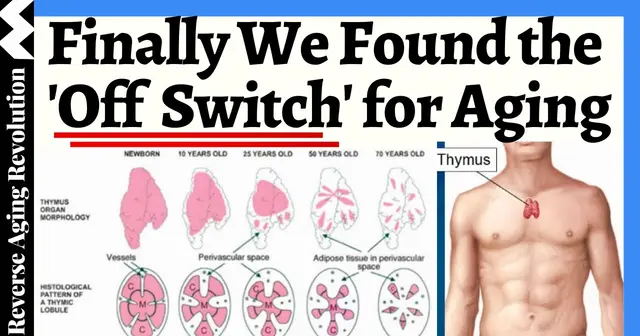
Talk reports thymus regrowth in older adults in TRIIM studies
A talk by Dr. Greg Fahy presents early data from the TRIIM and TRIIM-X studies, which, according to the video description, regenerated the thymus in older people.
- AgingPost
Aging as a continuation of developmental programs: a hypothesis
A social media post presents a hypothesis by researcher João Pedro de Magalhães that aging may be developmental programs that become harmful after reproductive maturity.
- AgingPaper
Citrulline and age-related fat buildup in C. elegans worms
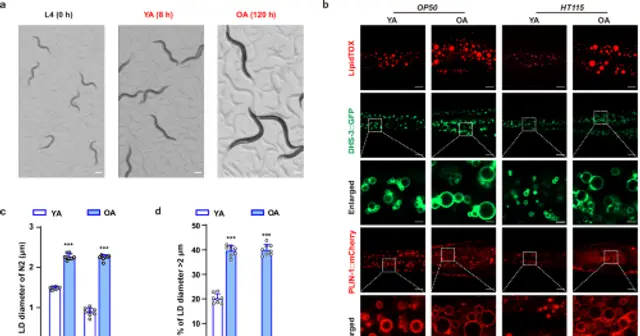
In a study of the C. elegans worm, more citrulline was linked to more age-related lipid buildup and a shorter lifespan. This is animal research, not yet shown to apply to people.
- AgingPost
Engineered enzyme reduced AGE damage in human tissue samples
A proof-of-concept study reported that an engineered enzyme removed advanced glycation end products from human tissue samples in the lab, lowering the damage to levels similar to those of a much younger person.
- AgingPaper
Enzyme reverses protein aging marker in lab and tissue samples
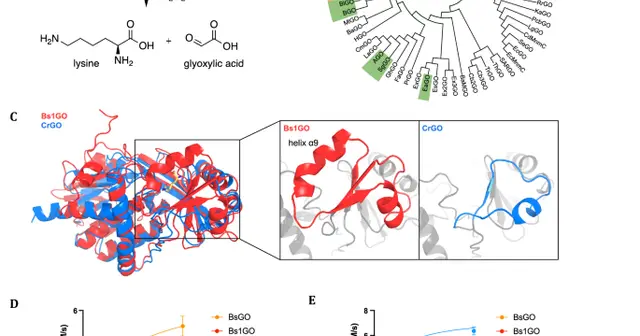
A study in Nature Communications describes an enzyme that can reverse an aging-linked protein damage marker in laboratory experiments and in human tissue samples. The results are preliminary.
- AgingArticle
Epigenetic aging clocks and biological aging in men with cardiometabolic disturbances
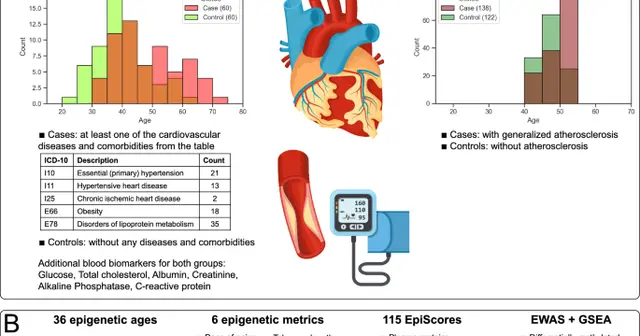
A study of men with cardiometabolic disturbances compared different epigenetic aging clocks. Some, including GrimAge and DunedinPACE, detected accelerated biological aging, while first-generation clocks largely did not.
- AgingArticle
Lacking LET-607 extends lifespan in animal study
A study in C. elegans worms reports that worms without the LET-607 protein lived longer, through a process linked to the cell's stress response. The results come from animals and have not been tested directly in people.
- AgingArticle
Longevity Aesthetics: A New Conceptual Framework for Aesthetic Medicine
A conceptual article proposes that aesthetic medicine move beyond correcting visible signs of aging and adopt a longevity model based on geroscience, which has not yet been tested in practice.
- AgingPost
Mouse study suggests TBMS1 compound removes senescent cells
A Tsinghua University team reported, in mice, that the TBMS1 compound removes senescent cells by acting on the ATP1A1 protein, improving several age-related conditions.

Not medical advice · Learn more