


Medicine
Studies, trials and discoveries in medicine, genetics and biology, explained without hype.
- MedicinePaper
AI agent learns to order tests and diagnose in simulated clinic
A preprint describes DiagAgent, an AI model trained with reinforcement learning in a simulated clinical setting to order tests in steps and reach diagnoses. The authors claim it outperforms other AI models, in a scenario they created themselves.
- MedicinePost
Chromium picolinate may reduce levothyroxine absorption in small study
A small study of seven healthy volunteers found that absorption of T4, the hormone levothyroxine delivers, fell by about 17% when chromium picolinate was taken together with it.
- MedicinePost
Study links thyroid markers with plantar fasciitis in North Indian patients
A study of people from northern India found higher TSH and lower thyroid hormone levels in those with plantar fasciitis than in those without the condition. The study's author describes this as a risk factor, but it is an association.
- MedicinePost
Thyroid function and testosterone: what the cited studies report
An article summarizes two cited studies, one comparing people and one in rats, that link thyroid problems with lower testosterone levels.
- MedicinePaper
AI model forecasts over 1,000 diseases and their timing in people
A study published in Nature describes Delphi-2M, a generative transformer model that estimates a person's future health across more than 1,000 diseases.
- MedicinePaper
Apollo: medical language models for six languages
A preprint on arXiv describes the development of large medical language models for the six most widely spoken languages, along with the creation of the multilingual ApolloCorpora dataset. The work has not yet undergone peer review.
- MedicinePaper
EchoJEPA: a foundation model for heart ultrasound videos
Researchers describe EchoJEPA, an artificial intelligence model trained on 18 million echocardiograms from 300,000 patients, in a preprint that has not yet been clinically validated.
- MedicinePaper
Google model generates summaries of pathology slide images
A preprint by Google researchers describes PathAlign, a language and vision model that writes short descriptions of whole pathology slide images, in a computational study.
- MedicinePaper
Google paper describes a multi-agent AI system for personal health
A Google paper describes a multi-agent AI system for personal health. Benchmark tests and a study with 20 participants showed better results than baselines, but there are no clinical outcomes.
- MedicineArticle
Google's AMIE diagnostic AI adds physician-review guardrail
Google Research and Google DeepMind describe g-AMIE, an extension of their diagnostic AI designed to produce a summary for a doctor to review, rather than direct guidance for patients.
- MedicinePaper
GPN-Star model aims to predict which DNA variants alter function
A preprint on bioRxiv describes GPN-Star, a genomic language model that, according to the authors, outperforms classic evolutionary methods at predicting the effects of DNA variants. The study is computational and has not yet been peer reviewed.
- MedicinePaper
MedRGB: a benchmark for testing medical AI question-answering systems
A publication presents MedRGB, a framework for evaluating whether medical AI systems recognize when evidence is missing or wrong.
- MedicineArticle
Pitfalls of AI in health care, according to a New Yorker feature
A New Yorker feature examines how large language models are changing medicine and what side effects this technology may bring. The piece was highlighted by Eric Topol.
- MedicinePaper
ReasonMed: a 370,000-example dataset for medical reasoning in AI
A preprint describes ReasonMed, a dataset of 370,000 medical reasoning examples for training AI systems. According to the authors, models trained on it outperformed others of up to 10B on PubMedQA.
- MedicinePaper
Heat shock proteins may buffer effects of some disease-causing mutations
A Nature news report suggests that molecular chaperones such as HSP90 may dampen the effects of harmful genetic mutations, which could help explain why some carriers are resistant to them.
- MedicineArticle
SHP protein found to protect cartilage in osteoarthritis mouse studies
A study published in Nature Communications reports that the SHP (NR0B2) protein protects cartilage in mice with osteoarthritis. The findings are early and come from animal experiments.
- MedicinePaper
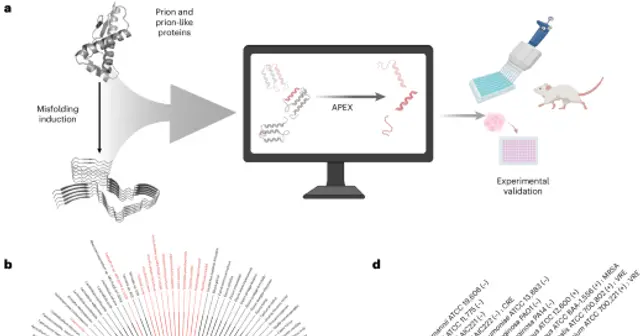
AI screening finds possible antimicrobial peptides in prion proteins
An AI screen of 19.3 million peptide fragments from 2,897 prion-related proteins flagged 1,179 possible antimicrobial candidates, and two reduced infections in mice in early results.
- MedicinePost
Supervised AI medical chat assistant rated safe in 926 interactions
A study of 926 real conversations describes Mo, a medical assistant based on AI and supervised by physicians, with replies rated safe by doctors in 95% of cases.
- MedicinePost
Zebra-Llama: AI model aimed at Ehlers-Danlos syndrome
An article describes Zebra-Llama, an AI model adapted to answer questions about Ehlers-Danlos syndrome, trained on text from PubMed, Reddit and patient forums. It reflects how AI tools for rare diseases are being built and stresses that independent testing is still needed.
- MedicineArticle
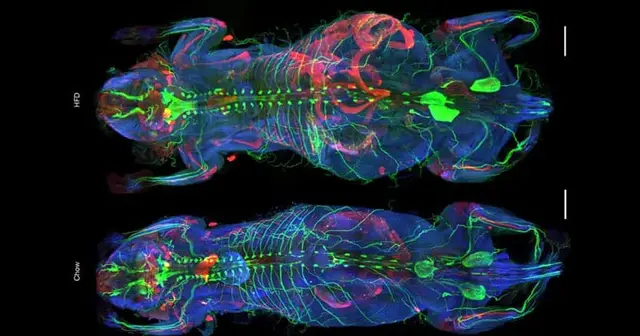
AI imaging maps obesity-related nerve damage across mouse organs
A Nature study used the MouseMapper AI tool to scan nerves and immune cells in 31 mouse organs. It reports obesity-related nerve damage beyond the extremities, and some of this may relate to GLP-1 drugs in humans.
- MedicineArticle
Blood p-tau217 level linked to later mild cognitive impairment in healthy adults
A JAMA study reports that blood p-tau217 levels predicted mild cognitive impairment years later in people without cognitive deficits at the start. The finding is still under research.
- MedicineArticle
Curcumin versus placebo for enlarged prostate: systematic review
A systematic review and meta-analysis linked curcumin supplements to better urinary symptoms and function in men with benign prostatic hyperplasia, compared with placebo.
- MedicineArticle
Deep learning on ECGs flags a hidden group at risk of sudden cardiac death
A machine learning model trained on thousands of electrocardiogram records identified a group of people at previously unrecognized risk, according to a Nature article.
- MedicineArticle
FDA approves first oral pill that blocks PCSK9 to lower LDL cholesterol
The FDA has approved the first oral pill that blocks PCSK9. According to the cited New York Times report, it would lower LDL cholesterol comparably to the injectable drugs Repatha and Praluent.
 arxiv.org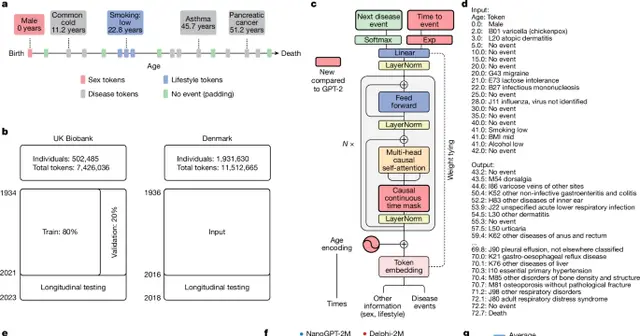

 biorxiv.org

Not medical advice · Learn more