


Hyperglycosylation Is Pointed to as a Factor in Alzheimer's Disease
A study combining spatial multiomics, isotope tracing and retrospective cohort analyses points to hyperglycosylation, a change in how sugars attach to proteins, as a possible factor in Alzheimer's disease.
Source: Hyperglycosylation identified as a driver of Alzheimer's disease (nature.com). Summary written with AI from the source and reviewed by rules; read the original.
What the research shows
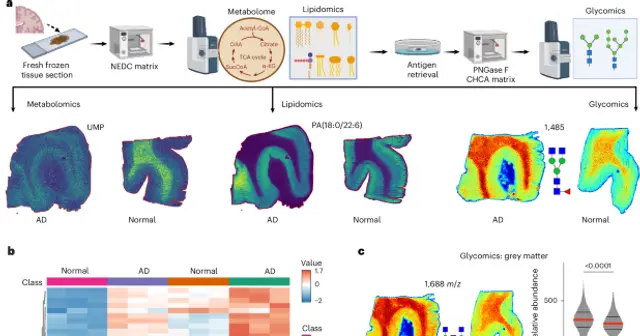
The study used three approaches: spatial multiomics, which maps molecules within tissue; isotope tracing, which follows labeled molecules over time; and analyses of a retrospective cohort, meaning data from people followed in the past. Based on these, the authors point to hyperglycosylation as a factor linked to Alzheimer's disease. The source does not report how many participants were included or how long they were followed.
Alzheimer's disease is the most common cause of dementia, and scientists are working to understand the biological processes behind it. Retrospective cohort analyses show associations but do not prove that one factor causes the disease. Results like these are generally considered preliminary until other studies, including clinical trials, confirm them. Research into possible factors in dementia may, in the future, point to new targets for treating brain diseases.
What it means
The finding suggests that the way sugars attach to proteins may be involved in Alzheimer's, which could guide future research. It is still unknown whether hyperglycosylation causes the disease, how much it contributes, or whether acting on it would be safe and effective.
How to read it with care
This study does not replace a medical consultation. Do not draw conclusions about prevention or treatment from it alone. Anyone considering a change in diet, supplements or treatment should talk to a doctor or another qualified health professional.