


Coffee compounds and mitochondrial health: a review
A review in the Journal of Translational Medicine links bioactive compounds in coffee, including caffeine, to the energy pathways of cells. It is an overview of an area still under development.
Source: Review on coffee compounds and mitochondrial health (link.springer.com). Summary written with AI from the source and reviewed by rules; read the original.
What the research shows
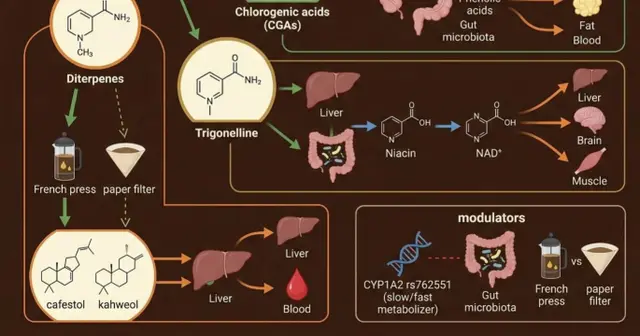
A review published in the Journal of Translational Medicine examines bioactive compounds in coffee, such as chlorogenic acids, trigonelline, diterpenes and melanoidins, as well as caffeine. The authors discuss how these substances may affect cellular metabolism and mitochondria, the structures that produce energy inside cells.
A review gathers and discusses existing research rather than testing a new group of people. The article links coffee's chemical components to the energy pathways of cells, a field that is still developing. Results from studies in cells or animals do not automatically apply to people, and the review does not prove that drinking coffee changes mitochondrial health in humans.
What it means
This review suggests coffee's compounds may interact with how cells produce energy. Because it is an overview of possible mechanisms, it does not show how much these effects matter for health. Much remains unknown about the effects in people.
How to read it with care
Read this as an overview of a developing research area, not as proof that coffee improves health. It does not replace a medical consultation. Anyone considering changes to diet, supplements or treatment should talk to a doctor or another qualified professional.